


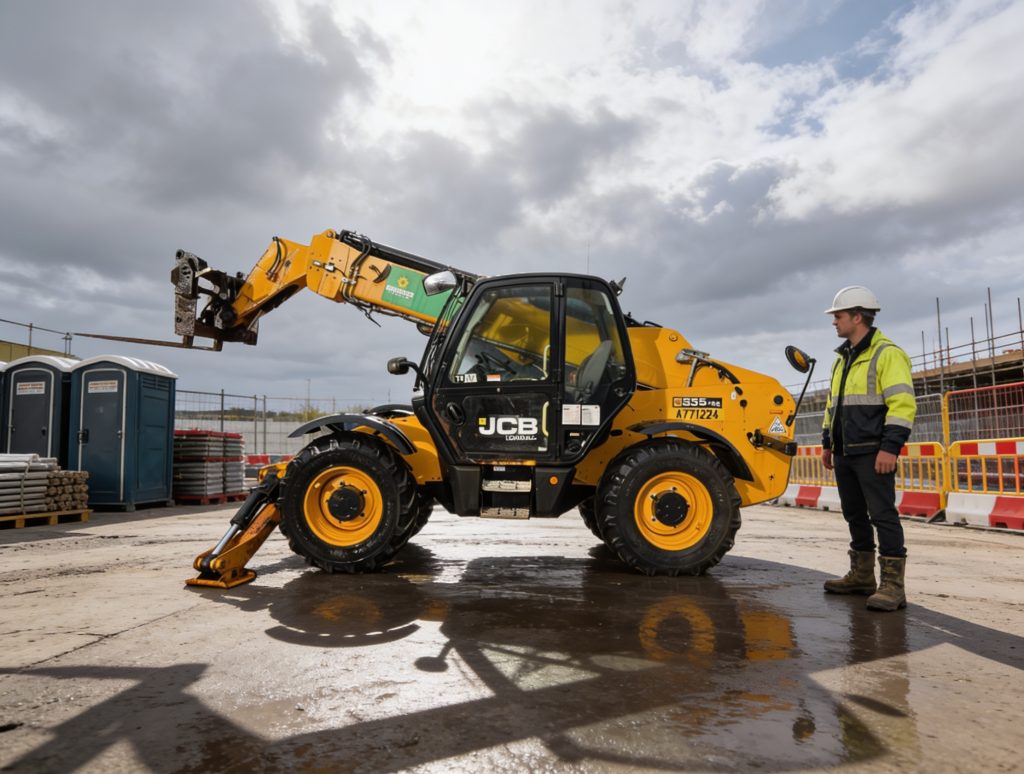
A used 12‑metre telehandler can be a sensible way to get reach on a UK job without paying new‑machine money, but only if it genuinely fits the site and the paperwork matches the iron. At 12 metres you’re into the zone where small differences in boom charts, tyre spec, stabilisers and attachments show up quickly on programme, especially when you’re feeding brick-and-block, roofing materials, cladding packs or M&E plant across mixed ground.
TL;DR
– Match the machine to the lift plan: reach/height is only half the story — capacity at radius and attachment choice decide what’s actually possible.
– Treat documentation and servicing history as evidence, not reassurance; gaps usually become downtime.
– Plan delivery, access, ground and traffic management early; 12‑metre machines are less forgiving in tight compounds.
– On used kit, condition checks should focus on boom wear, hydraulics, tyres, forks/attachments and safety systems, not just engine hours.
The hire-or-buy decision on a 12‑metre handler isn’t just about cost
A 12‑metre telehandler often sits right on the line between “general site workhorse” and “specialist reach machine”. If you only need the reach for one phase (roof trusses, high-level materials, podium works), hire can keep risk with the fleet owner and let you swap if the spec is wrong. Buying used tends to suit longer programmes, repeat work, or where you want consistent operator familiarity and attachments that stay with the machine.
There’s also the downtime angle. A used telehandler that’s mechanically sound but arrives with worn forks, a sloppy boom or tired tyres can still lose you hours every week through small stoppages, slow cycle times and additional banksman input. Hire rates can look higher on paper, but the real comparison is “productive lifts per day” once you’ve allowed for site constraints and support.
What “12 metres” means in the real world
The headline height doesn’t guarantee you can place what you want where you want it. Most site issues come from the gap between maximum height and the working envelope with a load on.
A few practical realities UK teams trip over:
– Capacity falls off fast as you reach out. A machine that will lift heavy close-in may feel underpowered when you’re trying to place at reach over a scaffold line or into a loading bay.
– Stabilised vs non-stabilised configurations change what’s possible and how you manage the footprint. Stabilisers can be brilliant on rough ground, but they complicate pedestrian routes and exclusion zones.
– Tyres matter. Industrial tyres on hardstanding behave differently to aggressive tread on wet stone; a used machine might be on the “wrong” set for your job.
– Attachments change the load centre and visibility. A jib, bucket or rotating head can turn a feasible lift into a no-go if you don’t allow for de-rating.
A site scenario that feels familiar
A refurbishment project in a town centre has a narrow rear access and a one-way delivery window shared with the dryliners and the roofing gang. The used 12‑metre telehandler turns up mid-morning, but the wagon can’t swing in because a scaffold lorry is already unloading, so the telehandler is offloaded on the street side under pressure. The operator gets waved through a tight gate, and the machine immediately starts scrubbing tyres on the turn because the ground transitions from tarmac to broken concrete. By lunchtime the supervisor is asking for truss packs to the roof, but the forks on the used machine are worn and the load keeps sitting further forward than expected. A spotter is pulled off another task to manage pedestrians because the boom work now needs a larger exclusion zone than planned. The handler can technically reach the roof line, but with the chosen attachment and the radius required, it’s slow and uncomfortable, so the roofing gang starts waiting. By day two, everyone is blaming the machine, but the root cause is a rushed handover and a lift plan that never matched the exact configuration on site.
Condition and paperwork: what good looks like when buying used
Used telehandlers in the UK change hands through dealers, auctions and direct sales, so “condition” can mean anything from ex-hire with routine inspections to lightly maintained site kit. Hours alone aren’t a reliable guide; heavy loading cycles and poor greasing can age a boom faster than engine time suggests.
Focus on evidence and wear points that cost time and money:
– Boom sections and pads: look for excessive play, uneven wear and signs of poor lubrication. Slop often shows up as bounce at height and imprecise placement.
– Hydraulics: damp rams, sweating hose ends and slow creep under load suggest upcoming work. Pay attention to auxiliary lines if you’ll run specialist attachments.
– Steering and brakes: check response on full lock and on gradients; a 12‑metre handler working around trades needs predictable handling.
– Safety systems: alarms, lights, load indicators and interlocks should behave consistently. Intermittent faults are the ones that appear when you’re busiest.
– Fork carriage and forks: check for wear, straightness and secure locking; worn forks can quietly ruin lift stability and handling.
On-delivery / pre-purchase walkaround (5–7 items)
– Confirm the exact model and boom chart, including any stabiliser configuration and the attachment fitted on the day.
– Look for boom play at mid and full extension, and listen for knocks when raising/lowering under light load.
– Run all hydraulics to full travel and hold position briefly to spot drift or jerky movement.
– Inspect forks/quick-hitch/attachment pins for wear and secure locking; verify the attachment is rated for the job you’re doing.
– Check tyres for uneven wear and damage, and match the tread type to your ground conditions and haul routes.
– Ask for service history and recent inspection records as practical evidence; note gaps, advisories and recurring faults.
Handover and site integration: where time gets lost
A 12‑metre telehandler touches multiple interfaces: deliveries, bricklayers, roofers, cladders, M&E, and often the site traffic plan. The machine can be mechanically fine yet still underperform because the workface isn’t set up for it.
The biggest productivity gains usually come from planning the “telehandler system”, not just the telehandler:
– Delivery point and storage: set down areas that avoid double handling and keep the boom work short and direct.
– Travel routes: keep them firm, drained and free of sudden cambers. If routes degrade, cycle times and stability both suffer.
– Exclusion zones: agree them with subcontractors early, especially when working at height near access routes.
– Operator and banksman roles: clear signals, consistent communication and a shared view of pinch points reduces stop-start working.
– Attachment control: keep the right attachment on the machine for the shift, rather than swapping reactively under pressure.
Common mistakes
1) Buying on headline lift height and maximum capacity, then discovering the required lift is at a radius where the machine won’t comfortably work. That becomes a daily compromise rather than a one-off inconvenience.
2) Accepting “recently serviced” without seeing what was actually done and what was advised. Hidden advisories often become your downtime.
3) Running one telehandler as a shared resource with no priority plan, so it spends half the day travelling and waiting between trades. The programme then forces risky short-cuts around exclusion zones.
4) Treating attachments as interchangeable without checking de-rating, compatibility and certification. Even a good operator can’t overcome the wrong setup.
Used vs hire: practical triggers that push you one way
Buying used tends to stack up when the machine will be on your sites consistently, you can keep a tight maintenance routine, and you have the yard discipline to manage attachments and daily checks. Hire tends to suit short bursts, uncertain ground conditions, or when you need flexibility (swap to stabilised, larger capacity, or different tyre spec) as the job evolves.
Also consider resale and reputational risk. If you buy a used 12‑metre handler and it starts failing on-site, it doesn’t just cost repairs; it disrupts multiple trades and creates pressure to “make it work” in marginal conditions. Hire can reduce that exposure, but only if the handover, documentation and site readiness are handled properly.
What to tighten before the next lift phase
If a used 12‑metre telehandler is coming onto a job for the next programme push, tighten the basics that stop small issues becoming big delays. Confirm the lift plan aligns with the actual attachment and configuration you’ll run, not the brochure ideal. Make sure the unloading point and travel route are still valid after recent groundworks and deliveries. Lock in who provides a banksman when pedestrian interfaces are busy, and don’t rely on “whoever’s free”. Finally, get clarity on what documentation will be held on site (and where) so shift changes don’t turn into guesswork.
The used market will keep moving with project starts, seasonal ground conditions and fleet replacement cycles, so availability and condition can swing quickly. The teams that stay productive are usually the ones that treat reach machines as a planned system: spec, ground, traffic, attachments and evidence all lining up.
FAQ
Do I need a special operator ticket for a 12‑metre telehandler in the UK?
Good practice is to use an operator who’s trained and assessed for the class of telehandler and the type of work being done (including attachments). Many sites will also expect familiarisation on the specific model and configuration. If the job involves lifting people in a platform or unusual attachments, the competence expectations tend to be higher.
What should I ask about delivery and offloading on a tight site?
Get the delivery vehicle type, arrival window, and where the machine will be offloaded confirmed in advance. Consider gate widths, turning space, overhead restrictions and whether you’ll need traffic management for the unloading area. If the planned offload point changes on the day, reassess pedestrian routes and exclusion zones before starting work.
How do I stop the telehandler becoming a bottleneck between trades?
Allocate time windows or priorities so one trade doesn’t strand another, and keep set-down areas organised to reduce double handling. Make attachment choice a planned decision per shift rather than ad hoc swapping. Where multiple gangs rely on the handler, a banksman plan and clear call-off process prevents constant interruptions.
What documentation is worth seeing when buying used?
Service records, inspection history and any documentation relating to attachments are useful as evidence of how the machine’s been looked after. It’s also sensible to see notes of advisories and repairs, not just stamps, so you understand what’s been recurring. If paperwork is patchy, build that risk into your downtime expectations and pre-start checks.
When should I escalate a used-machine issue rather than “working around it”?
Escalate if there’s inconsistent braking/steering, unusual boom movement, hydraulic drift, warning systems behaving erratically, or anything that affects stability and control at height. Also escalate if the job is forcing repeated near-misses around pedestrians or exclusion zones because the machine can’t perform the lift as planned. Small mechanical issues and small planning issues often combine into one big incident risk if left to drift.


