


.
Merlo P32.6 3.2t 6m Telehandler – RS Machinery Blog
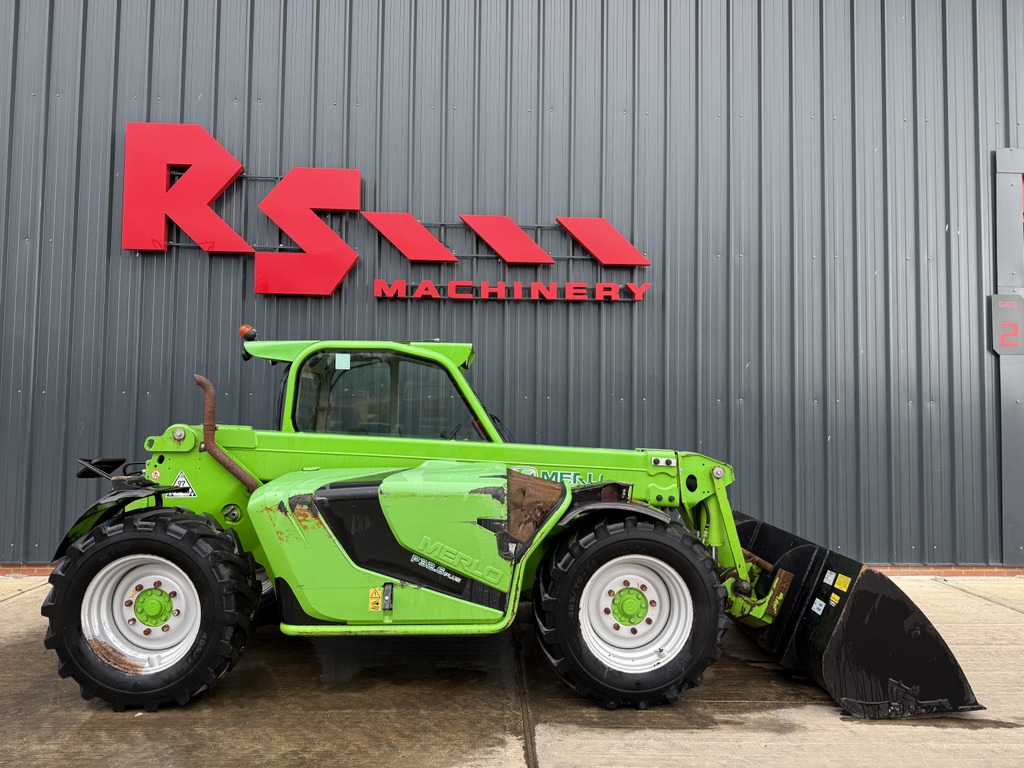
There are plenty of jobs where a full-size telehandler is more machine than the site really wants. It may have the reach, the lift and the presence, but it can also bring width, weight and a certain reluctance to thread itself through awkward gateways, unfinished yards or tight building plots without making a meal of it. That is where a compact telehandler such as this Merlo P32.6 starts to make proper sense.
This is a 3.2 tonne, 6 metre class telehandler with 4x4x4 drive, a four-cylinder Kubota diesel engine and hydrostatic transmission. On paper, those details tell part of the story. In the real world, they describe a machine built for shifting materials, feeding work areas, loading, unloading and generally reducing the amount of hard graft needed to keep a job moving. With a maximum lift capacity of 3,200 kg and a maximum lift height of 6.40 m, it sits in that useful middle ground where it is compact enough to get into sensible spaces, but still capable enough to do work that would otherwise swallow up labour, time and patience.
The dimensions are worth noting because they matter on actual sites. At approximately 4,220 mm long, 2,000 mm wide and 2,150 mm high, this Merlo P32.6 is not trying to be a huge yard machine. It is the sort of telehandler that can be considered for cramped construction work, agricultural yards, estate maintenance, landscaping projects and contractor use where access is often just as important as lift capacity. Anyone who regularly works around tight access will understand the appeal.
Stworzony do pracy, z którą zmagają się większe maszyny
A compact telehandler earns its keep when a site is not set up like a brochure photograph. Real jobs often involve narrow entrances, soft ground, parked vans, stacks of materials in the wrong place and a delivery driver waiting with the engine running. A larger machine may handle the load but struggle with the route. This Merlo P32.6 is better suited to those situations where the machine needs to get in, position itself sensibly and work without causing a drama.
The 4x4x4 drive layout is particularly relevant on mixed and awkward ground. Sites are rarely perfect underfoot, especially through a British winter, and a telehandler that can manoeuvre confidently is far more useful than one that looks impressive but spends too much time being nursed around ruts and soft patches. Muddy entrances, uneven yard surfaces and partly finished groundworks all favour simple, dependable traction and good control.
The hydrostatic transmission also suits the kind of stop-start work telehandlers often face. Loading materials, inching towards pallets, placing bulk bags, collecting attachments and feeding trades all involve constant forward and reverse movement. Fine control matters. Operators generally appreciate a machine that responds smoothly without making every adjustment feel like a wrestling match.
Its 2 metre width is also a practical point rather than just a number. On domestic builds, farm tracks, landscaping work and urban refurbishments, that width can make the difference between getting the machine where it needs to be and having to double-handle everything from the roadside. Double-handling is one of those quiet costs that creeps into a job. Nobody writes a song about it, but everyone notices when it disappears.
With a full cab, air conditioning and front and rear working lights, this particular machine is also set up for more than fair-weather yard duties. Bad weather and short winter days are part of the job in the UK, and operators tend to value proper visibility, shelter and basic comfort more as the hours add up. A machine that remains usable in wet, cold or low-light conditions helps keep work moving when conditions are less than charming.
To rodzaj maszyny, do której posiadania wykonawcy szybko się przyzwyczajają
The Merlo P32.6 suits buyers who need a telehandler for varied, everyday work rather than one single specialised task. Groundworkers may use it for moving packs of blocks, pipe, drainage materials or trench support. Builders may need it for unloading deliveries, placing materials nearer to the working area and reducing barrow work across rough ground. Landscapers may use it for bulk bags, stone, timber, turf, soil and site clearance. On farms and estates, it can move between yard work, feeding, loading, general handling and maintenance support.
Agricultural businesses often value compact machinery that does not feel oversized in older yards or buildings. Not every farm was designed around modern plant dimensions. Stone walls, low sheds, narrow tracks and uneven concrete can make larger handlers awkward. A compact 6 metre telehandler can be a more natural fit for day-to-day handling where manoeuvrability is just as useful as outright reach.
For contractors moving between sites, a machine of this size also has an obvious appeal. It is still a serious piece of plant at around 6,150 kg, so transport needs to be planned properly, but it is not in the same category as some much larger telehandlers that demand more space, more thought and more room to operate once they arrive. On jobs where access is limited and ground conditions change through the week, that matters.
Plant hire firms may also see the attraction. Compact telehandlers are often requested because they cover a wide spread of site tasks without being too intimidating for competent operators. The joystick control on this machine helps with usability, particularly for repetitive handling. Good operator controls do not just make life more pleasant; they help reduce clumsy handling, wasted movement and fatigue as the day wears on.
For smaller builders and owner-operators, a machine like the P32.6 can replace a surprising amount of manual effort. It will not remove the need for skilled labour, but it can stop skilled people spending too much of the day dragging, lifting, carrying and shifting materials by hand. That is where compact plant often makes its strongest argument. It lets people get on with the work they are actually paid to do.
Dlaczego takie maszyny po cichu zarabiają na swoje utrzymanie
The value of a compact telehandler is not always dramatic. It often shows itself in small savings repeated all day. One less man needed to move materials. Fewer delays waiting for a delivery to be repositioned. Less time spent dragging pallets across rough ground. Fewer machines cluttering a cramped site. Less strain on operators and labourers. By the end of a week, those small gains are not quite so small.
The Merlo P32.6 has enough lift capacity for serious site handling, while the 6.40 m lift height gives useful reach for stacking, loading and placing materials. It is not trying to be a high-reach heavy-duty telehandler for the largest commercial jobs. Its strength lies in being compact and capable in the same package. That balance is often more useful than chasing bigger figures that may rarely be needed.
A Kubota diesel engine is a familiar and reassuring detail for many machinery buyers. Operators and owners tend to like engines with a reputation for straightforward service support and dependable running. No engine is maintenance-free, of course, and any used machine should be assessed properly, but a known diesel unit is one of those details that makes a buyer look twice for the right reasons.
Hydrostatic drive can also be a practical benefit for operators who spend their time manoeuvring rather than simply travelling from one end of a site to the other. Telehandler work is often about careful positioning. Approaching a stack, lifting, placing, reversing, turning, lining up again. A transmission that allows smooth, controlled movement reduces the stop-start irritation that can make a long day feel longer than it needs to.
The included bucket adds useful flexibility. While buyers will naturally consider the attachments they need for their own work, having a bucket with the machine makes it more versatile for loading loose material, clearing, tidying and general site duties. Many machines earn their place not because they do one glamorous job, but because they can handle a dozen ordinary ones without fuss.
There is also a hydraulic tow hitch listed with this machine, which may prove useful in yards, estates, agricultural settings and certain contractor environments where trailers and equipment need moving around site. As always, buyers should match towing use to the correct site conditions and requirements, but it is a practical addition rather than a decorative one.
Tam, gdzie ta maszyna sprawdza się najlepiej
On a small construction site, the Merlo P32.6 can be the difference between a tidy workflow and a daily argument with materials. Packs of blocks can be moved closer to the bricklayers. Timber can be repositioned without dragging it through mud. Deliveries can be unloaded without relying on someone else’s machine arriving at the right moment. In the real world, having control over material movement often keeps the whole job calmer.
For groundwork projects, a compact telehandler can support drainage, foundations, kerbing and site preparation work. It can move trench boxes, pipe, stone, fittings and equipment around areas where a bigger machine may struggle to turn. Groundwork jobs are rarely neat for long. Once excavations, spoil heaps and temporary access routes appear, manoeuvrability becomes more valuable than it looked at the start.
Landscaping work is another natural environment for this size of telehandler. Bulk bags, topsoil, stone, sleepers, fencing materials and paving can all take time and energy to shift by hand or with smaller kit. A 6 metre telehandler gives useful lift and reach without being so large that it dominates the whole site. In larger gardens, estates or commercial landscaping schemes, that can make the working day far more efficient.
On farms, the P32.6’s compact dimensions and 4×4 capability suit a wide range of yard and field-edge tasks. It may be used for handling feed, moving pallets, loading, general maintenance or supporting seasonal work. Its full cab and working lights are practical for agricultural use, where early starts, late finishes and unpleasant weather are not exactly rare events.
Utility contractors and maintenance teams may also find this type of machine useful where access is restricted and the ground is uncertain. Working around verges, compounds, temporary roads and confined urban areas often requires kit that can turn up, get positioned and work without needing the entire site rearranged around it. That is where compact machinery has a habit of becoming the first thing people ask for in the morning.
In urban jobs, the reduced footprint is particularly useful. Not every site offers the luxury of wide turning areas or generous storage. A machine that can handle meaningful loads while remaining relatively compact helps keep materials off the pavement, away from traffic management headaches and closer to the people using them. That may not sound glamorous, but on a tight city job it can be worth a great deal.
Rodzaj maszyny, którą docenia się po długim dniu na budowie
Operator comfort is easy to underestimate until someone spends eight or nine hours in and out of the cab. This Merlo P32.6 is equipped with a full cab and air conditioning, which makes a real difference across a working season. Warm, wet days can be tiring in a cab with poor ventilation, while cold weather soon exposes machines that offer little shelter. A comfortable operator is usually a smoother, more patient and more productive operator.
Joystick control also matters in daily use. Telehandler work involves repeated boom and attachment movements, often while positioning the machine accurately in less than perfect surroundings. Controls that fall naturally to hand reduce fatigue and help the operator work with a bit more finesse. You notice that sort of thing after a full day of loading, placing and shifting.
Visibility and lighting are part of the same picture. Front and rear working lights help when the job starts early, finishes late or simply gets swallowed by a gloomy afternoon in November. Anyone who has tried to finish a yard job under miserable light will know that proper working lights are not a luxury. They are part of keeping the machine useful when the weather and clock are not helping.
Good tyres are also mentioned with this machine, and that is not a throwaway detail. Tyres affect traction, stability, comfort and confidence, especially on mixed ground. On wet sites, simple dependable machinery usually wins, but it still needs the contact with the ground to do its job properly. Buyers of used plant quite rightly look at tyres because they are both a working component and a future ownership cost.
Another practical point is the operator’s manual. It may sound mundane, but it helps owners and operators understand correct use, daily checks and maintenance routines. Used machinery is often only as good as the way it is looked after, and having the right information to hand supports better ownership. There is nothing clever about guessing a service point in the rain when the manual would have told you in thirty seconds.
Site stress is often caused by small delays rather than one great catastrophe. A pallet is in the wrong place. The delivery cannot get close enough. The ground has cut up. The labourers are already busy elsewhere. A compact telehandler like this does not solve every problem, but it gives the site more options. That flexibility is often what operators come to value most.
Rozsądne dopasowanie dla kupujących myślących długoterminowo
Buying a used telehandler should always start with the work, not the badge. The Merlo P32.6 is best considered by buyers who need compact handling ability, useful lift capacity and everyday manoeuvrability. If the regular workload involves very high reach or consistently heavy lifting at greater distances, a larger machine may be more suitable. If the work involves tight access, mixed ground and constant material movement, this size of machine becomes much more compelling.
Access restrictions should be looked at honestly. With a width of around 2,000 mm and a height of around 2,150 mm, this machine will suit many restricted environments, but every yard, barn, site entrance and gateway is different. Sensible buyers will measure the places where the machine actually needs to work, not just the easiest entrance. The awkward corner is usually where reality lives.
Transport is another consideration. At approximately 6,150 kg, this is a compact telehandler but still a substantial item of plant. Buyers should think about how often it will move, what transport is available and whether delivery between sites will be part of the operating routine. For many contractors and agricultural users, arranged transport is a straightforward part of ownership, but it should be accounted for properly.
Payload and attachment use should also be matched to the intended jobs. The listed maximum lift capacity of 3,200 kg and maximum lift height of 6.40 m make this machine suitable for a wide range of material handling tasks, but operators should always work within the machine’s rated capacities and conditions. Good telehandler ownership is partly about knowing what the machine can do, and partly about knowing when not to ask too much of it.
Servicing and maintenance should be viewed as part of the purchase decision rather than an afterthought. A compact telehandler that is checked regularly, greased properly and maintained sensibly will usually repay that attention. For buyers relying on a machine day after day, downtime is not just inconvenient; it can disrupt labour, deliveries and the order of work across a site.
Operator requirements matter too. A machine with a full cab, air conditioning, joystick control and working lights is better suited to regular use than something very basic. Comfort, control and visibility are not just nice additions. They affect how confidently and accurately the machine is used, particularly in poor weather or confined areas.
Dostępne za pośrednictwem RS Machinery
This Merlo P32.6 is available through RS Machinery, with UK buyers able to enquire directly and export enquiries also welcome. Transport can be arranged at an additional cost, which is useful for buyers planning delivery to a site, yard, farm or onward shipping destination. More details can be found here: Merlo P32.6 3.2t 6m Telehandler – RS Machinery Blog.
For contractors, agricultural businesses and machinery buyers looking for a compact used telehandler with practical lift capacity, 4x4x4 drive, hydrostatic transmission and a working specification suited to real site conditions, the Merlo P32.6 is a machine worth considering carefully. It is not about making a statement in the yard. It is about having a capable handler that can get into useful places, keep materials moving and make awkward jobs that little bit easier.


