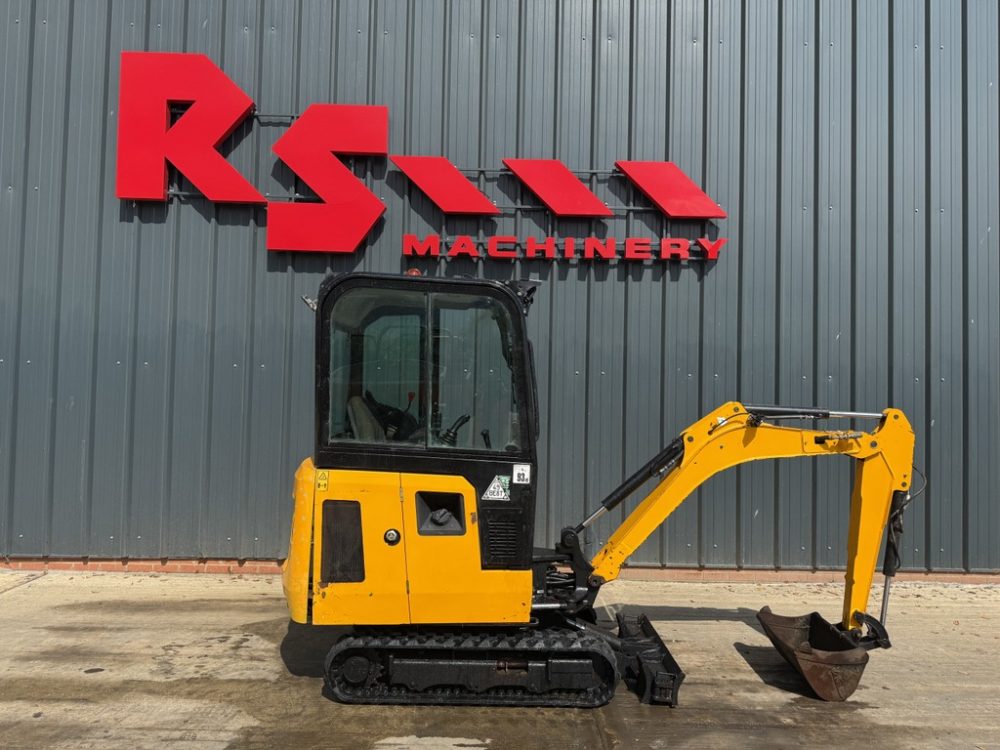
JCB 16C-1 1.7t Mini Excavator
There are plenty of jobs where a full-sized excavator is simply too much machine. Not too powerful, necessarily, but too wide, too heavy, too awkward to get into position and too much hassle once the site starts closing in around you. The JCB 16C-1 1.7t Mini Excavator sits in that useful compact class where access, transport and day-to-day practicality matter just as much as digging performance.
At 1,749 kg, this is the sort of mini excavator that appeals to contractors, builders, landscapers, farms and small works crews who regularly find themselves dealing with narrow gateways, restricted gardens, tight urban plots and ground that has already had enough punishment for one week. With its 3-cylinder Perkins diesel engine, extending undercarriage, twin speed tracks, dozer blade and full heated cab, this JCB 16C-1 is clearly set up for real working conditions rather than fair-weather demonstrations on level concrete.
Its maximum digging depth of 2,426 mm gives it useful reach for drainage, services, landscaping preparation, footings and general groundwork, while the compact dimensions make it easier to place where a larger excavator would quickly become an inconvenience. Anyone who regularly works around tight access will understand the appeal. Sometimes the machine that gets through the gap and starts work without drama is the one that saves the day.
Створено для роботи, з якою великі машини не справляються
The main strength of the JCB 16C-1 is not just that it is compact. Plenty of compact machinery exists. The point is that this machine combines small-site access with enough working ability to be genuinely useful once it arrives. With a width of 980 mm in its narrow configuration and an extending undercarriage taking it out to 1330 mm when stability is needed, it suits the kind of stop-start, awkward, real-world work that larger plant can make unnecessarily complicated.
On domestic groundwork, that can mean getting through a side gate, across a driveway or into the back of a property without turning the whole job into a logistics exercise. On farm or estate work, it may be reaching a drainage run, a ditch edge, a yard corner or a boundary repair where access is poor and the ground is soft. On urban jobs, it might simply be a case of working between walls, fences, scaffolding and parked vans, which is where many machines begin to feel much larger than their brochure suggests.
The twin speed tracks are a practical touch for moving around site. Nobody wants a compact excavator that feels painfully slow when shifting from one end of a job to another, especially when the operator is already trying to keep several people supplied with spoil, trenches or prepared ground. The dozer blade also earns its keep in ordinary ways: grading off, stabilising during digging, pushing loose material aside and tidying up without having to call another machine over for every small task.
Wet ground is another area where compact equipment often proves its worth. A lighter machine still needs sensible operation, of course, but the JCB 16C-1 gives crews a better chance of working without causing unnecessary damage or becoming a burden on the site. On muddy ground, simple dependable machinery usually wins. This is especially true when the job has to continue despite the weather doing its usual British impression of being personally offended by progress.
Підрядники швидко звикають до того, що у них є такі машини
For small and medium-sized contractors, a 1.7 tonne excavator often becomes one of the most frequently used machines in the yard. It is not usually the most dramatic bit of plant on the fleet, but it tends to be the one that goes out again and again because it fits so many jobs. The JCB 16C-1 is well suited to builders handling footings and drainage, landscapers preparing levels and features, groundwork crews opening trenches, and utility contractors working in confined spaces.
Farms and agricultural businesses can also make good use of this size of machine. It is compact enough to move around yards and buildings, useful for small drainage work, repairs, trenching and general digging, and far more efficient than trying to do everything by hand or tying up a larger excavator for a small task. Estates, equestrian properties and rural businesses often have the same issue: plenty of practical jobs to do, but not always the space or justification for larger plant.
Plant hire firms may also see the appeal. A compact JCB mini excavator with a heated cab, auxiliary hydraulic circuit piping, work lights and a straightforward working layout can suit a wide range of customers. Hire users tend to value equipment that is easy to understand, predictable in use and not overly fussy. If a machine can go to a landscaper one week, a builder the next and a smallholder after that, it stands a better chance of earning its place.
For contractors moving between sites, transport practicality matters. A machine of this size can be easier to plan around than heavier equipment, particularly for smaller outfits that have to think carefully about trailers, towing arrangements and site access. It is one thing to own a capable machine; it is another to get it to the right place without turning every job into a transport puzzle. The JCB 16C-1 sits in that useful bracket where mobility is part of the machine’s value.
Чому такі машини спокійно заробляють собі на життя
Compact excavators are not always appreciated properly until a business has lived with one for a while. The JCB 16C-1 is the sort of machine that can reduce wasted labour, shorten awkward manual tasks and make smaller jobs more controllable. A trench that might otherwise take a team far too long with spades becomes a more efficient operation. A garden clearance, drainage repair or foundation dig can be approached with more confidence. That is where the real value lies.
The Perkins diesel engine, rated at 12.2 kW, gives the machine the working character expected in this class without overcomplicating matters. Buyers looking at used machinery are often interested in machines that feel familiar, serviceable and sensible rather than unnecessarily complex. In day-to-day plant ownership, simplicity has a habit of becoming more attractive the longer you own the machine.
The auxiliary hydraulic circuit piping adds useful flexibility, depending on the attachments a buyer intends to run. Even where the machine is mainly used with its supplied bucket, having auxiliary provision broadens the potential workload. It gives an owner more options for the future without needing the machine to become something it is not. For many contractors, that flexibility can be the difference between sending one machine to site or having to organise additional equipment.
The extending undercarriage is another practical feature that matters more in use than it does on paper. Narrow access is valuable, but stability is equally important once the machine is working. Being able to reduce the width for access and extend it for working gives the operator more confidence when conditions are less than perfect. It is a good example of compact machinery designed around the reality of awkward sites rather than idealised ones.
Operator comfort also plays its part. A full heated cab may sound like a small luxury until you are working through a cold morning, wet ground and a long list of jobs that will not wait. On British sites, weather is not a minor detail. Keeping the operator warm, dry and focused helps productivity and reduces fatigue. It also makes the machine more appealing across the full year, not just during the few weeks when the weather behaves itself.
Де ця машина має тенденцію проявляти себе найбільше
The JCB 16C-1 is especially useful on compact construction sites where space disappears quickly. Once materials arrive, scaffolding goes up, skips appear and access routes narrow, a larger excavator can become difficult to position. A 1.7 tonne mini excavator can keep working in areas where bigger plant would need constant repositioning or may not get in at all.
For groundwork projects, the maximum digging depth of 2,426 mm gives useful capability for many common tasks, including drainage, service trenches and preparation work. It is not a replacement for a larger excavator where heavier digging or greater reach is required, but that is not the point. Its strength is in completing the smaller and tighter jobs efficiently, without bringing unnecessary size and weight to the site.
Landscaping is another natural fit. Many landscaping jobs involve mixed tasks: cutting levels, removing roots, digging footings for walls, shaping ground, moving small quantities of spoil and working around boundaries that were never designed with machinery in mind. In that setting, a compact excavator with a dozer blade and reasonable digging depth can change the pace of the job considerably.
Utility work often calls for compact equipment too. Service trenches, repairs and small excavation tasks may take place in streets, yards, verges, gardens or business premises where disruption needs to be kept under control. A machine like the JCB 16C-1 can be positioned more easily and moved with less fuss, which matters when the working area is shared with pedestrians, traffic, customers or other trades.
On farms, the machine can prove useful in those practical jobs that appear without warning: clearing a blocked ditch, sorting a yard edge, opening a trench, repairing a water line or tidying around buildings. Farmers and rural contractors often appreciate equipment that can do a bit of everything without needing a full convoy to move it. Some machines earn their place quietly simply by making awkward jobs easier.
Машина, яку ви цінуєте після довгого робочого дня на будівництві
Operator experience is where compact excavators can either become a pleasure to use or a source of constant irritation. The JCB 16C-1 has the kind of layout and working size that suits regular site use, particularly where the operator is in and out of tight areas all day. Good visibility, manageable dimensions and predictable movement all help when there is very little room for guesswork.
The full heated cab is worth mentioning again because it affects how the machine feels over a proper working day. Cold, wet operators make slower decisions, take more breaks and generally enjoy life less. A cabbed compact excavator is far more civilised on winter jobs, early starts and damp sites where open-station machines can become tiring. It is a small comfort until the weather turns, at which point it becomes a rather sensible feature.
Work lights add further practicality, especially for shorter winter days, shaded sites, farmyards and jobs that run later than planned. Most operators know the feeling of trying to finish one last trench or tidy a work area as the light fades. Having proper lighting on the machine helps keep work safer and more controlled, rather than relying on a van parked at an optimistic angle.
Ease of movement around site also reduces stress. A compact machine with twin speed tracking is easier to reposition, load and set to work without wasting too much time. That matters when several trades are waiting, the concrete delivery is booked, the customer is asking questions and the weather forecast has taken a turn for the theatrical. The less fuss the machine creates, the better the day tends to go.
Maintenance and reliability are always part of the ownership conversation with used construction equipment. Buyers will naturally want to inspect condition, service history where available, wear points, hydraulics, undercarriage condition and general presentation. But as a type of machine, a straightforward compact excavator from a familiar name like JCB makes sense for businesses wanting usable plant rather than something obscure or difficult to support.
Розумний вибір для покупців, які думають про довгострокову перспективу
Before choosing a compact excavator such as the JCB 16C-1, it is worth being honest about the work it will be expected to do. If the main requirement is heavy bulk excavation or deep drainage work every day, a larger machine may be more suitable. But where the workload involves tight access, domestic and commercial groundwork, landscaping, small civil works, estate maintenance, farm tasks and general contractor use, this size of excavator can be a very sensible fit.
Transport should be considered carefully. The 1,749 kg operating weight places the machine in a compact category, but buyers still need to think about suitable trailers, towing vehicles, loading arrangements and legal weight limits. It is not just whether a machine can be moved, but whether it can be moved easily and regularly without creating problems for the business. For many buyers, that is one of the strongest arguments for this class of plant equipment.
Access is another key point. The narrow width of 980 mm gives the machine genuine usefulness for restricted sites, while the extending undercarriage helps when a wider stance is preferred for working. Buyers dealing with housing projects, garden work, utilities or older rural properties will know that access restrictions can decide whether a machine is useful before it even starts digging.
Intended attachments and hydraulic requirements should also be considered. This machine is fitted with auxiliary hydraulic circuit piping, which can support wider use depending on the attachment setup. A buyer planning future attachment use should check compatibility carefully, but the presence of auxiliary hydraulics is a practical advantage for those wanting more from their compact machinery over time.
Operator requirements matter too. A heated cab, work lights and a familiar compact excavator layout all support regular use. If a machine is comfortable and straightforward, it is more likely to be used well. If it is awkward, exposed or tiring, operators tend to notice by mid-afternoon, usually in language unsuitable for polite company.
Long-term practicality is often about whether a machine fits the business rather than whether it looks impressive on paper. The JCB 16C-1 is not trying to be a large excavator. Its value lies in being compact, usable, transportable and capable enough for the steady stream of smaller jobs that keep contractors, farms and plant operators busy. For many buyers, that is exactly the point.
Доступно через RS Machinery
This JCB 16C-1 1.7t Mini Excavator is available through RS Machinery, with UK buyers welcome to enquire about the machine and its suitability for their work. Export enquiries are also welcome, and transport can be arranged at an additional cost for buyers who need the machine moved to site, yard or port. Further details are available here: JCB 16C-1 1.7t Mini Excavator – RS Machinery Blog.
For contractors, builders, landscapers, agricultural businesses and machinery buyers looking for a compact excavator with practical working features, this JCB 16C-1 deserves consideration. It is the sort of machine that makes sense not because it shouts about itself, but because it can get into awkward places, do useful work and help keep jobs moving when space, weather and time are all working against you.